
In amongst our new science books this month, is Lee Berger’s new book Cave of Bones — which follows the discovery of thousands of bones of a new hominin species, Homo naledi, in a cave deep underground in South Africa. This book is sending waves through the scientific world and not just for its exciting new discoveries. It is causing controversy for a variety of reasons; these include the speed the team worked to publish their findings and the involvement of the media through the making of a documentary for Netflix. Nevertheless, Berger has made his findings accessible to others allowing for discussion and analysis. If you want to hear more about both sides of the story, check out the episode covering this controversy on the Science Vs podcast or make up your own mind by reading the book yourself – link below!
Check out our new science books:
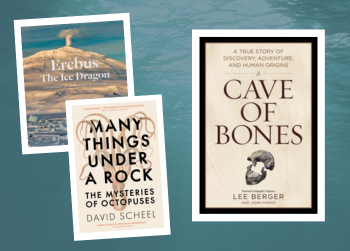
Cave of bones : a true story of discovery, adventure, and human origins / Berger, Lee R | Audiobook Available for Cave of bones
“Deep in the dark, stalactite-filled chambers of South Africa’s Rising Star cave system, internationally acclaimed paleoanthropologist Lee Berger and his intrepid team of explorers have found thousands of fossil bones from Homo naledi. It’s a tale rife with determination and discovery, challenging long-held assumptions about our evolutionary past and offering astounding implications poised to overturn the very definition of what it means to be human.” (Adapted from Catalogue)
Many things under a rock : the mysteries of octopuses / Scheel, David
“Of all the creatures of the deep blue, none captivates us quite like the octopus. Marine biologist David Scheel’s lifelong preoccupation with octopuses has led to a career of groundbreaking research, from finding previously unknown species to the discovery of signalling communication among octopuses. The octopus is sometimes called the most alien animal on the planet, but here we learn just how much the octopus is like us. And how much we are like the octopus.” (Adapted from Catalogue)
The swimmer : the wild life of Roger Deakin / Barkham, Patrick
“Roger Deakin is best known for his modern classic of nature writing, Waterlog, which frog-kicked the wild swimming movement into existence with wit, politics and poetry. But he was not simply a dazzling writer and eccentric Englishman. Barkham draws from notebooks, diaries, letters, recordings, published work and early drafts, to conjure his voice back to glorious life in these pages. Barkham’s biography follows Roger Deakin’s tree of life, from roots to fruits, revealing the inner life of an extraordinary man.” (Adapted from Catalogue)
Erebus the ice dragon : a portrait of an Antarctic volcano / Monteath, Colin
“Haunting and searingly beautiful, Erebus has attracted explorers, mountaineers, artists and scientists; each drawn to the mountain by their own particular vision or curiosity. Antarctica veteran Monteath weaves history, science, art and adventure into a compelling tale, supported by superb images selected from his lifetime of working and voyaging in the area.” (Adapted from Catalogue)
The heat will kill you first : life and death on a scorched planet / Goodell, Jeff | Audiobook Available
“The Heat Will Kill You First is about the extreme ways in which our planet is already changing. As an award-winning journalist who has been at the forefront of environmental journalism for decades, Goodell’s new book may be his most provocative yet, explaining how extreme heat will dramatically change the world as we know it.” (Adapted from Catalogue)
Demystifying orchid pollination : stories of sex, lies and obsession / Karremans, Adam P.
“Demystifying Orchid Pollination explores the fascinating natural history of orchids and the extraordinary means by which they reproduce. With sections named after famous songs and quotes sprinkled throughout the text, this is a truly engaging and fascinating read, leaving no stone unturned when it comes to the fertilization of orchid flowers.” (Adapted from Catalogue)
Better living through birding : notes from a Black man in the natural world / Cooper, Christian
“Christian Cooper is a self-described Blerd (Black nerd), an avid comics fan, and an expert birder who devotes every spring to gazing upon the migratory birds that stop to rest in Central Park, just a subway ride away from where he lives in New York City. Better Living Through Birding is Cooper’s invitation into the wonderful world of birds, and what they can teach us about life, if only we would stop and listen.” (Adapted from Catalogue)
Around the ocean in 80 fish & other sea life / Scales, Helen
“Dive beneath the waves to meet 80 of the ocean’s strangest and most surprising inhabitants. This beautifully illustrated aquatic world tour tells the fascinating stories of beguiling sea creatures and their ingenious feats of survival – from producing anti-freeze to enduring boiling temperatures – revealing the ways in which these seemingly remote creatures have shapes our own lives, whether through medicine, culture or folklore.” (Catalogue)
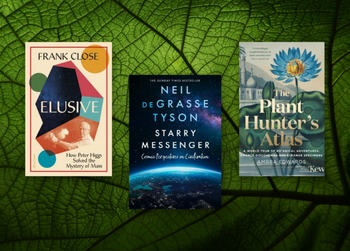
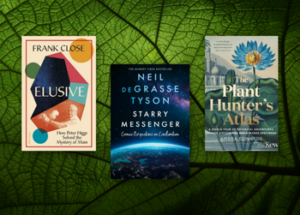 This month’s recent picks of the new science books feature a ‘biography’ of the Higgs boson particle — tracing the pathway to its discovery across the course of twentieth century physics. Plus, discover the world as it’s perceived by other animals, read Neil deGrasse Tyson’s latest, and follow dauntless explorers through the centuries as they discover and illustrate botanic specimens. Plus, what happens when science and the media collide. Have a browse!