
Scottish Genealogy

Welcome!
If you are beginning to search for ancestors who lived north of Hadrian's Wall - whether Lowland, Highland, or the Islands - this page is for you.
FREE Online Subscriptions - only from computers within Wellington City Libraries.
Of particular interest are:
- Scotland Census records from 1841 - 1901
- Selected extracted parish records, arranged by county
- Selected other lists arranged geographically e.g. Fife Voters Lists, 1832-1894, Marriage Registers, 1794-1895, Perth Register of Deeds, 1566-1811
* Find my Past - Ireland
* Find my Past - UK Once you're at mygateway.info use the drop-down menu at the top to select the database title.
Books
Recent books:
 Abandoned women : Scottish convicts exiled beyond the seas, by Lucy Frost.
Although not a conventional genealogy book, this contains an often overlooked slice of social history. From the crowded tenements of Edinburgh to the Female Factory nestling in the shadow of Mt Wellington, dozens of Scottish women convicts were exiled to Van Diemen's Land with their young children. This is a rich and evocative account of the lives of women at the bottom of society two hundred years ago. (drawn from Syndetics)
 Scottishness and Irishness in New Zealand since 1840, by Angela McCarthy. (2011)
Although often negated as distinct peoples or subsumed under pakeha, this book examines the distinctive aspects, mixed and complex, of Scottish and Irish ethnic identities in NZ. This is a mine of information for anyone researching Scottish relatives arriving off boats in the nineteenth century. Based on personal testimonies (incorporating letters, shipboard journals, memoirs, and interviews), official immigration files, parliamentary debates, nominated immigration records, maritime ephemera, ethnic presses, society records, lunatic asylum casebooks, family histories, poetry and novels, and film and documentary.
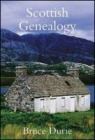 Scottish genealogy, by Bruce Durie. (2009).
This steps the user through the main uptodate sources including the Census online (to 1911), old parish registers and statutory records, local records, wills and testaments, sasines and other land documents as well as current topics such as DNA testing. A great uptodate starting point focusing specifically on Scotland.
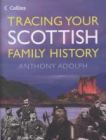 Collins tracing your Scottish family history, by Anthony Adolph. (2008).
Pitched more at a beginner's level.
Collins tracing your Scottish family history, by Anthony Adolph. (2008).
Pitched more at a beginner's level.
"Renowned genealogist Anthony Adolph unveils a wide range of tools and information available, specific to discovering your Scottish ancestry - whether you are starting your trail in Scotland or from somewhere else in the world. The text is packed with weblinks to enable you to search the great number of records now available online, as well as providing contact information on other sources, such as archives and libraries. By reading this book you'll also be drawn into the lives your ancestors led, through the examples, compelling stories and fascinating social history which are interwoven within the text. ..." (drawn from the publisher)
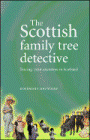 The Scottish family tree detective : tracing your ancestors in Scotland, by Rosemary Bigwood. (2006).
A practical, user-friendly guide to researching your family history in Scotland.... It shows how to make the most of research resources and catalogues of collections held in archives and libraries, both online and on paper. Emphasis is laid on locating, selecting, evaluating and using sources, as well as finding out what is locally available and what is kept in Scottish central archives. Guidance is given on how to keep records and make a research plan. Other sections look at topics such as birth, marriage and death, how to use the core sources of statutory registers, census returns and parish registers. (book jacket).
'How to' introductions:
Scottish roots : the step-by-step guide to tracing your ancestors, by Alwyn Jones. (2002).
A step-by-step guide to tracing Scottish ancestry, using an example of two Scots trying to discover their roots. Jones covers how to start the research process and gradually layer up a picture of the overall family tree.
Discovering your Scottish ancestors : how to find and record your unique heritage, by Linda Jonas & Paul Milner. (2002).
One of the more up-to-date resources, it assumes living outside Scotland in the "electronic era". Definitely written from a practical point of view, rather than theoretical, Jonas and Milner step the reader through the records of an actual family to illustrate how it can be done.
Ancestral trails : the complete guide to British genealogy and family history, by Mark D. Herber. (1997)
Again, although getting a little dated now, if its helpful to have Scotland within its wider British context, much information can be found in this 674 page tome.
Gathering the clans : tracing Scottish ancestry on the Internet, by Alan Stewart. (2004)
As the title suggests, this has an emphasis on using the internet as a tool for tracing your Scottish heritage.
Going abroad, by John MacGibbon. (1997)
Although this is the story of MacGibbon family who emigrated to Otago and Southland, this well-illustrated book contains many historical examples of documents of the time (1840s-1860s). Examples include NZ Company advertisements, food rations on board ship, all which contribute to painting a slice of life - why people came, and what they encountered en route and here.
The statistical atlas of England, Scotland and Ireland, , [edited] by G. Phillips Bevan. (1882)
A fascinating thematic atlas reflecting surveys on agriculture, crime, education, law, marine, military and naval, Poor Law and pauperism, politics, population, religion, etc.
To consult this book ask at the Second Floor Desk, Central Library. It cannot be borrowed.
Magazines
Lending genealogy magazines are shelved in the Art, Music & Literature Magazine collection on the first floor of the Central Library. There is only one specialist title : Scottish genealogist but you may also find related articles in general magazines such as:
Births and baptisms
Official state records didn't commence until 1855. Before this date, the best 'single' source is the Old Parochial Registers (OPRs), compiled from the Church of Scotland parish books, and the index can be found as part of the International Genealogical Index (IGI). There are now a range of ways of accessing this information and which you select is likely to depend on the stage of your research and the depth of your pockets.
When beginning, we suggest the free Church of the Latter Day Saints Family History Search Service. It's not comprehensive, and there are whole books devoted to its foibles, including spelling by the (often) English registrar of unfamiliar accents, but its a good place to start.
Scotland's people is the official government source of genealogical data for Scotland as the General Register Office of Scotland site. Use to access details of records after1855, but it also contains the OPRs to provide more complete coverage. It also contains the Catholic Parish registers. Some of the OPR information appears as transcripts, although the project to digitise the actual registers is well underway.
It costs 6 pound for 30 "page credits" which are valid for 90 consecutive days. Viewing a page of index results costs 1 credit and each page will contain up to 25 search results. Viewing an image costs 5 credits (equivalent to 1GBP). From the search results you may view, save and print images.
Charging is based on the number of pages actually displayed, not on the number of records. Each time you do a search, you are told how many records have been found. Before displaying the records, you have the opportunity to re-define, and narrow the search, without displaying the results. By juggling search parameters e.g. date, do consider re-defining the searches, maximise what can be determined without downloading spurious results needlessly.
Microfilms of Old Registers may also be ordered via the Family History Search Service (Church of Latter Day Saints, Hataitai). It may be more laborious, but does have other advantages, such as cost (a microfilm roll may contain a whole register costs about $5 for viewing, which is a saving if many ancestors' details will be included within the one film).
Census information
From 1841 there were national censuses every ten years - 1851, 1861 etc. There were isolated pockets of earlier censuses, but usually these were counts rather than detailed dwelling and individual records of these years. Scotland's People now includes 1911 Census information. Census records up to 1911 are now available on the Library's Ancestry.com subscription which is available for free on our library internet computers.
Treat "exact" ages given in the census cautiously, particularly in the earlier ones. Both the occupants and/or the officials had a tendency to round ages up or down, seemingly without any reason other than that was 'close enough'.
Hot tip:
Although it is by no means complete, a free census record site is available at www.freebmd.org.uk - FreeCEN. More records are being uploaded by volunteers regularly. Standard search options are available.
Deaths, monumental inscriptions and wills
For actual death records after 1855, see something like Scotland's people, which includes up to 1952.
Deaths are more rarely recorded in the Old Parochial Registers. A more common source is the cemetery records, usually referred to MIs, or monumental inscriptions. These are for sale very cheaply from the Scottish Genealogy Society Online Shop . (Note that some societies have excellent indexes that you can try before buying, though.) In addition, historians and genealogical society volunteers have spent much energy transcribing many cemeteries and many are available directly on the internet - so its also worthwhile doing a general internet search for your parish or district. Just put keyword details e.g. Rousay cemeteries, into a search engine like Google.
Wills are also available via the Family Search Service of the Church of the Latter Days Saints, but increasingly are available from Scottish Documents Online. They offer free access to a fully searchable index of over 350,000 Scottish wills and testaments dating from 1500 to 1875 (soon to be extended to 1901) with a copy for sale at 5GBP per document. They also hold many other court records.
Examples of wills include:
- Dundee Wills, Inventories and Confirmations, 1832-1875 (SC45/31/1-26)
- Kirkwall Wills, Inventories and Confirmations, 1827-1875 (SC11/38/1-8)
- Lerwick Inventories, 1827-1875 (SC12/36/1-6)
Searching
The main book sequence for Scottish genealogy is at 929.1072 but there will also be related materials at 929.8 (tartans) and 929.2 (general family history).
Search tip
If you want to browse all we have on Scottish genealogy, then Select the EasyFind catalogue and enter Scotland genealogy into the search box.
When you're just browsing, EasyFind is a better option because from the main results list you can then either browse the list of titles shown, or further refine your search easily, for example sorting by year, or author.
Languages
Handwriting
Even when in English, some early documents can be impossible to decipher!
Scottishhandwriting.com is a website offering online tuition in palaeography for historians, genealogists and other researchers who have problems reading manuscript historical records written in Scotland in the 16th, 17th and 18th centuries. The emphasis of the website is on practical help, with tutorials and a weekly tip.
Scots
Like English, Scots stems from Anglo Saxon. It is spoken in Lowland Scotland. A passing understanding of it may help unravel some old handwriting or inventive spellings in documents! Here's a selection of resources about Scots:
(Sites can be viewed in Scots or English.)
Marriages
Marriages can be searched for in the same way as births, as above - via the OPRs (IGI) until 1855.
Historically, although monogamy and marriage was important, the actual 'wedding' in Scotland has never been given the same sacramental status as elsewhere, even if performed in the Kirk. For example, it was common to be married at home (by the minister), with a separate Kirk service at another time. Women often retained their "maiden name".
In the parochial registers you may find several stages or just one of the following recorded in the Register of Marriages :
1) The "Consignation of Pledges" - pledge by the couple that (a) they would definitely marry, and (b) that they would abstain from sexual relations until that marriage. This practice had largely died out by the start of the 19th century.
2),3),4) The "Proclamations". (similar to the banns) Sometimes more than one is recorded on the same date - if there was a risk that a child might be born before 9 months had elapsed, the Kirk might be persuaded to make more than one on the same day (for a fee, of course).
5) The marriage itself. Sometimes there can be two dates recorded for one "marriage" if the bride and groom were from different parishes.
Military
The UK National Archives holds discharge papers for soldiers who were discharged to pension from 1760-1913. They are held in the WO 97 series (where WO stands for War Office). You can search the catalogue online. Use the form to order the actual records if you wish, although there may be sufficient information in the index as it lists place of birth, age at discharge, regiment, and dates of service.
Names (See also tartans and clans)
Naming patterns in Scotland
Although there are a lot of exceptions, it can be a very useful tool in working back through the generations. For example, when you have found a family in a Census (so you know the names of the children), but you can't at first distinguish the birth records of the parents, because there is a choice in the IGI (International Genealogical Index). The ones sharing the children's names are more probably the ones.
1st daughter = mother's mother, 1st son = father's father, 2nd daughter = father's mother, 2nd son = mother's father, 3rd daughter = mother, 3rd son = father.
From this point often the pattern is to go in turn through parent's brothers and sisters in order of age (i.e. 4th son is usually father's oldest brother). However, it is common for the pattern to break down from the fourth child onwards, and by the time one gets to the 12th child they may have searched rather further afield.
The naming pattern is also one reason that there may be more than one child with the same name, particularly if the earlier child died. The second child is not likely to be named after the sibling, but to keep the grandparent's name pattern intact. Also, what we might regard as variants of the same name may occur within the one family if the grandmothers/mother also share the one name, for example one child called Margaret and another child called Maggie.
Another common naming practice was for the mother's family name to be given to all the children in addition to the above e.g. Annie Mackie Fyfe, Susan Mackie Fyfe.
As long as this is treated as clues (which need to be verified) then the naming pattern can save a lot of time.
Places and maps
Websites
Sasines
This is a legal document that records the transfer of an interest (usually a sale or an inheritance) in a piece of land or building. It will normally detail the names of the new and previous owners and will give a basic description of the property transferred. There will usually be an indication of the price paid for the property.
Although few actually owned land, when you do find one that is relevant, sasines can also give you information about family history, particularly where an individual is passing land to another family member, or where the family designation is revealed (e.g. 'John Campbell of X'). Sometimes information given in one sasine will give you clues as to earlier titles in the chain and so lead you back to the earlier history of the ownership of a building or piece of land.
When land interest was transferred in Scotland, the transaction was recorded in the Registers of Sasines. From 1617 to 1868 there was a General Register of Sasines for property anywhere in Scotland, and Particular Registers of Sasines for the lands belonging to each district. They contains all the recorded Minutes (precis of deeds) in chronological order so it can provide a history of a property, eg its owners, charges, mortgages, etc.
Sasines indexes and records are available through the Family History Centres at the Church of the Latter Day Saints, which have copies from the National Archives of Scotland.
Shipping to New Zealand
Websites
Ships and passengers from Scotland to New Zealand.
Excellent site with many further helpful links.
Books
White Wings, by Henry Brett. (1924). 2 vols.
If you're looking for more details about the ship and voyages, then this is a great starting place. Most ships have a photograph, and approximately one page of information.
More information can be found in The colonial clippers.
Statistical Accounts
Statistical Accounts of Scotland These were a series of very detailed accounts prepared in 1799 and 1845 for each parish. A mine of social history information, containing details such as topography and natural history (including geology, botany, zoology - such as lists of birds), civic history - "eminent men", land-owners, buildings, population, industry, livestock and produce, economy, church and other sundry titbits e.g. 1845 Methlick (Aberdeenshire) reads "In 1841 a parish library was instituted for the purpose of affording instructive and religios reading to the parishioners. There were about 80 subscribers, and nearly 400 volumes."
Tartans, and clans
 The illustrated encyclopedia of tartan : a complete history and visual guide to over 400 famous tartans, by Iain Zaczek and Charles Phillips.
This highly readable illustrated account of the history of the tartan covers suppression and revival, regimental tartans, and the directory includes families and modern tartans as well as the major clans.
The illustrated encyclopedia of tartan : a complete history and visual guide to over 400 famous tartans, by Iain Zaczek and Charles Phillips.
This highly readable illustrated account of the history of the tartan covers suppression and revival, regimental tartans, and the directory includes families and modern tartans as well as the major clans.
 Collins Scottish clan & family encyclopedia / [compiled and edited by] George Way of Plean and Romilly Squire.
One of the advantages of this books is that it is not simply restricted to a few Highland familiies. There is a lending as well as reference copy at the Central Library. There are many other books on tartans shelved at 929.8.
Collins Scottish clan & family encyclopedia / [compiled and edited by] George Way of Plean and Romilly Squire.
One of the advantages of this books is that it is not simply restricted to a few Highland familiies. There is a lending as well as reference copy at the Central Library. There are many other books on tartans shelved at 929.8.
Essential Scottish websites
Remember! A huge amount of what's available online is American-authored. Bear this in mind when subscribing to some sites which advertise the ability to search zillions of international names. Very few of them will be Scottish.
- Scotland'sPeople
The official government source of genealogical data for Scotland as the General Register Office of Scotland site. Containing 80 million Scottish related records, this is the single most important site to be familiar with, even if only using it selectively and prudently. An extensive help section. - FamilySearch, including Scottish OPRs, and 1881 British Census (but not Scotland, despite appearances).
- Scotland on GENUKI
As well as national family history resources, provide wonderful county level access. - Cyndi's List for Scotland
Major internet directory. Also - Cyndi's List - Scotland County Index . The best overall genealogical website directory has recently overhauled its Scottish section to provide a better directory by Scottish County. - Scottish Timeline
- Transcripts of Various Acts of Parliament of interest to the Genealogist.
Full texts of various Acts relating to birth, deaths and marriages.
Contact us
Have a comment or suggestion for this page? We would love to hear your comments and suggestions for improving this page! Contact the author of this page