
Ngā Kā Rēra i Te Whanganui-a-Tara, 1878-1964 Trams in Wellington, 1878-1964
Other heritage topics
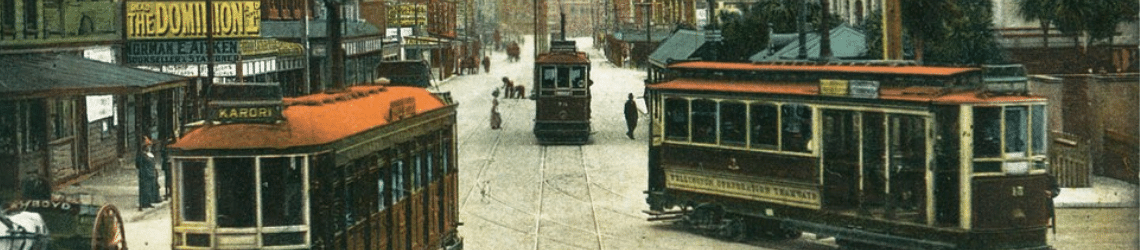
For the 86 years between 1878 and 1964, public transport in Wellington was dominated by the tram. Today we might think of trams as a heavy, antiquated form of public transport, but for an earlier generation they went beyond being a cheap way to move around the city - they were one of the most important infrastructural developments in Wellington's history and their impact can still be seen today.
The history of tramway development in Wellington can be separated into two distinct periods - from 1878 to 1904, and from 1904 to 1964. The library has many resources to help you research this fascinating aspect of Wellington's urban history.
Beginnings (1878-1904)
The first trams in Wellington looked more like small steam trains. Launched in August 1878, they consisted of a small steam engine which hauled a single passenger car. There was one main route which ran from the Railway Station to the southern end of Adelaide Road, just up from the Basin Reserve which was where the tram depot was located. There was also a short branch line to Queens Wharf via Lambton Quay and Grey Street. For a number of reasons the steam trams were not a success. They belched smoke and fumes, were noisy, and their heavy weight hammered the mild steel rails which needed constant repair. The noise problem was of particular concern as they could easily frighten the horses used for pulling cabs and carriages. Panicking horses were more than just a nuisance - they could be deadly to pedestrians.
Because of these reasons, in 1882 the heavy steam trams gave way to a return to older technology - horse drawn trams. These proved to be popular with Wellingtonians and the lines were extended to Tinakori Road and to Courtenay Place - a move which was directly responsible for turning Courtenay Place into a public transport hub.
1900 marked the year which saw the beginning of the changes that would lead to trams changing the face of Wellington. The Wellington City Council began negotiations with the private company that owned and operated the tramway and in August of that year, control passed to the Council and the Wellington City Tramways Department was born.
At issue was the future development of the city. At the time, Wellington City only covered Thorndon, Lambton, Te Aro, Mt Victoria, Mt Cook, Newtown and Berhampore. Into this area squeezed well over 40,000 people - over 10,000 more than live in the same area today. Wellington had become a highly congested and over-crowded city with slums developing in some quarters.
Later years (1904-1964)
In 1903, the predominantly rural area controlled by the Melrose Borough Council (consisting of Roseneath, Hataitai, Kilbirnie, Lyall Bay, Island Bay, Melrose, Ohiro Bay, Happy Valley, Brooklyn, and Kelburn) merged with the WCC to became part of Wellington City. The union of these two local authorities helped opened up large areas of largely undeveloped land that was perfect for new housing. Though many people were interested in building new houses and communities, any such development was not likely to succeed unless there was a way in which people could easily get and from the central city for work and entertainment. The motorcar had only just been invented and was expensive, unreliable, and considered only as toys for the very wealthy. Roads were rough and largely unsealed meaning dust in summer and mud in winter - not that practical for walking or bicycle riding. Horses were not practical option for many working families and required expensive stabling.
In a move planned to help Wellington develop, the City Council borrowed £225,000 (a huge sum of money for the times) to invest in the extension and electrification of tramway network. By 1911 the total amount borrowed had increased to £645,000 - an extraordinary figure considering the small population at the time.
A separate power station was built (there was no national electricity grid at the time), kilometres of hard steel track were laid, an overhead wire system was strung up and tram sheds and tram stops were constructed. On the 30th June 1904 the new era began with a short run through Newtown. Within months the main route through the city was completed and by 1907, trams were running through the Hataitai Tunnel to Kilbirnie, Miramar and Seatoun, through Berhampore to Island Bay, and up to Brooklyn and Karori Cemetery. These opened up large tracts of land and suburbs of Wellington began to boom. By 1911, extensions were laid to Karori Park and up to Wadestown.
For the next 50 years, life in Wellington was dependent on the tram as a means of transport, but gradually city planners began to realise that their days were numbered. Many of Wellington's streets were very narrow by Australasian standards and large trams lumbering down the centre-line of the road didn't mix well with increasing numbers of cars. Buses were seen to be the future, being much a more manoeuvrable and safer form of public transport. By the late 1950's routes began to close, and on 2nd May 1964, the last surviving tramcar route in New Zealand (Thorndon to Newtown) came to a close.
Though Wellington's trams now exist only as museum pieces, their legacy can still be seen today. The Hataitai tram tunnel running through Mt Victoria is still used by buses and many of the gently sloping roads used to access hill suburbs such as Wadestown, Brooklyn and Karori owe their existence to the major engineering work which was required to lay tram tracks to these areas.